
10 Things You Need to Understand Before Buying an Alberta Acreage
Your complete roadmap for rural property due diligence—from wells and septic to zoning, financing, and everything in between.
Quick Property Search
Rocky View · Foothills · Mountain View · MD of Bighorn
Buying an acreage near Calgary is one of the most rewarding decisions you can make—and one of the most complex. The same freedoms that make rural living so appealing also come with responsibilities that urban buyers are hardly ever prepared for.
At HappyHouseHunting.ca, we specialize in rural property transactions across Rocky View County, Foothills County, Mountain View County, and MD of Bighorn. The ten points below represent the most critical knowledge gaps we see acreage buyers walk into. Understanding them before you make an offer can be the difference between a dream property and a very expensive education.
Quick Check-In
What's drawing you toward acreage living?
You Are Now the Utility Manager
In the city, water comes from the tap and waste disappears when you flush. You've never had to think about either of those things. On an acreage, you are the water department and the sewer department. This isn't a small adjustment—it's a fundamental shift in your relationship with your home.
“The two questions every acreage buyer should ask first: Where does my water come from, and where does my waste go?”
— The foundation of every rural property evaluation we conductYour water comes from a drilled well, powered by a submersible pump you must maintain, service, and eventually replace. Your waste goes into a private septic system—typically a tank and field—that you must pump regularly, monitor, and keep compliant with provincial standards. Both systems can fail. Both failures are expensive. Both are entirely manageable with the right knowledge and preparation.
Your Septic System: The Other Half of the Equation
Visual Guide
How a Typical Acreage Septic System Works
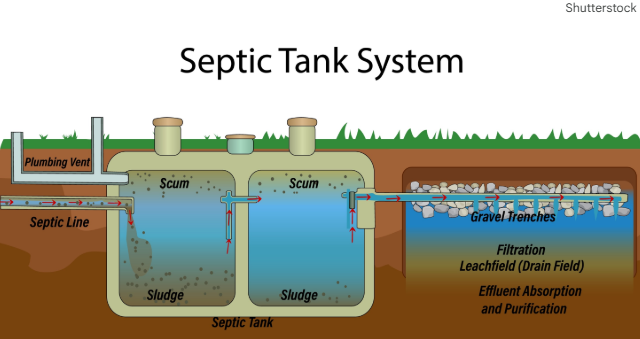
Septic Tank
Separates solids (sludge) from liquids. Scum floats; sludge sinks. The middle liquid layer flows to the field. Requires pumping every 3–5 years.
Drain Field
Effluent filters through gravel trenches and soil for natural purification. A saturated or failing field is the most expensive septic repair—$15,000–$40,000.
2021 Standard
Systems installed before the 2021 Alberta Private Sewage Standard are not automatically grandfathered. Always hire a certified septic inspector before removing conditions.
What You Need to Budget For
Annual well pump service: $150–$300. Septic pumping every 3–5 years: $400–$700. Well pressure tank replacement (every 10–15 years): $800–$1,500. Full well pump replacement: $3,000–$8,000 depending on depth. Septic field replacement if required: $15,000–$40,000. These are manageable costs—but only if you plan for them.
Understanding Well Flow Rates
Not all wells are equal. Before you make an offer, understand exactly what the flow test result means for day-to-day living—and for your financing options:
| Flow Rate | Status | What to Expect |
|---|---|---|
| 10+ GPM | Excellent | No restrictions; you can irrigate the lawn and shower simultaneously. |
| 5–10 GPM | Standard | Comfortable for a family; no extra storage usually required. |
| 2–4 GPM | Functional | Low; you'll need to be careful with “peak” use (e.g., don't run the dishwasher while showering). |
| < 1 GPM | Critical | Requires a 1,000+ gallon cistern. Very difficult to get traditional financing. |
Critical Due Diligence: Water & Waste
These are non-negotiable conditions on every rural offer we write. Do not remove conditions until all three are satisfactory.
Water & Waste Conditions Management
We coordinate all water and septic conditions on your behalf—booking certified contractors, reviewing results against current standards, and negotiating remediation or price adjustments if issues are found. We've reviewed hundreds of well reports and septic inspections across Rocky View, Foothills, and Mountain View Counties, and we know the difference between a red flag and a manageable disclosure. You'll never be handed a test result you can't interpret.
Financing is Fundamentally Different
This is the point that surprises most buyers coming from the Calgary market. The mortgage you qualified for to buy a city home does not automatically work for an acreage. Rural property financing operates under a completely different set of lender rules—and many buyers discover this at the worst possible moment.
| Property Type | Typical Down Payment Required | Key Lender Concern |
|---|---|---|
| Rural residential (home on acreage, under 10 acres) | 20–25% | Well & septic compliance, comparable sales |
| Larger acreage (10–40 acres, residential use) | 25–35% | Marketability, distance from urban centre |
| Agricultural or mixed-use land | 35–50% | Income potential, farming viability |
| Raw land (no dwelling) | 50%+ | Development potential, servicing costs |
| Outbuildings (shops, barns, arenas) | May be “appraised out” | Lender may not lend on their value—you pay the gap in cash |
The “Appraised Out” Problem
If a property has a large shop, riding arena, or barn, the lender's appraiser may assign it minimal value—or none. If the home appraises at $750,000 but you're paying $950,000 (because of a $200,000 shop), you may need to fund that $200,000 gap entirely in cash, above your down payment. This catches buyers off guard. We model this scenario before you make any offer.
Rural Financing Pre-Planning
Before you tour a single property, we walk through your financing picture with a mortgage broker who specializes in Alberta rural properties. We assess your down payment capacity against the specific type of acreage you're targeting, identify any appraisal gap risk on properties with significant outbuildings, and ensure you're pre-approved in a way that will actually hold up when the lender sees the property. Starting with the right pre-approval saves enormous heartache later.
Zoning Rules Vary Dramatically by County
This is the most misunderstood aspect of rural property purchasing near Calgary. Every county in Alberta has its own Land Use Bylaw—and they are not interchangeable. What your neighbour is doing on their property tells you almost nothing about what you're allowed to do on yours.
The most common example: a buyer sees horses on the property next door, assumes horses are permitted, purchases the property, and then discovers their specific district classification—“Country Residential,” “Hamlet,” or “Acreage Residential”—does not permit livestock. The horses next door may be on a differently-zoned parcel, or may be grandfathered. Either way, you cannot rely on it.
| County | Key Characteristics | Watch For |
|---|---|---|
| Rocky View County | Closest to Calgary, highest density rural development. More permissive on accessory buildings and secondary suites in some districts. | Fragmented district classifications—two adjacent parcels can have very different permitted uses. |
| Foothills County | Broader agricultural emphasis. More livestock-friendly in agricultural districts. Strong heritage and environmental overlay zones. | Environmental reserve setbacks near foothills terrain, Oldman River basin restrictions. |
| Mountain View County | Stricter on secondary dwelling units. Strong agricultural preservation mandate. | Limits on dwelling units per parcel are more restrictive than other counties. |
| MD of Bighorn | Conservation and tourism focus. More restrictive on development, but strong short-term rental and tourism accommodation permissions in some zones. | Bow River corridor restrictions. Very limited development in some overlay zones. |
Always Check “Animal Units” in the Bylaw
If livestock matters to you—horses, cattle, chickens, goats—find the specific district description in the applicable Land Use Bylaw and verify the animal unit calculation for your parcel size. A “Country Residential” parcel of 4 acres may permit 2 animal units. An “Agricultural” parcel of the same size may permit significantly more. The number and type of animals allowed is tied to your district designation and parcel size—not just the acreage label in the listing.
Land Use Bylaw Verification — All Four Counties
We maintain detailed working knowledge of the Land Use Bylaws for Rocky View County, Foothills County, Mountain View County, and MD of Bighorn. Before you remove conditions on any property, we pull the specific district designation, verify your intended uses against the Permitted and Discretionary Use tables, and confirm animal unit allowances for your parcel size. If a use is Discretionary rather than Permitted, we explain exactly what that approval process looks like and what the risk is. You will never be surprised by a zoning restriction after the fact.
Critical Due Diligence: Legal & Land
These items must be reviewed before conditions are removed. Each has caused a failed transaction or post-purchase surprise for buyers who skipped them.
Your Driveway is Your Responsibility
The county plows the secondary highway. They will not plow your 200-meter private driveway—not even once. This detail, which seems minor in July, becomes your first major reality check at 6:15 AM on a January morning when you need to be at work and your driveway has 30 centimetres of fresh snow on it.
Planning Your Winter Access Strategy
Most rural homeowners choose one of three approaches: a skid-steer or tractor with a blade attachment (most capable, highest capital cost, $15,000–$45,000), a heavy-duty ATV or UTV with a plow kit (effective for shorter driveways, $8,000–$18,000), or a contracted local service (variable cost, variable reliability—always have a backup plan). For properties with long, curved, or steep driveways, a tractor is not a luxury. It's a utility bill.
Beyond snow removal, consider the driveway surface itself. Gravel driveways require annual top-dressing ($800–$2,500 depending on length). Drainage ditches must be maintained or culverts become plugged. If spring flooding or heavy rain turns your driveway to mud, you may be unable to access the property until it dries—or you invest in proper gravelling and drainage infrastructure.
Driveway & Access Assessment
During every property showing, we assess driveway length, grade, drainage condition, and surface quality—and give you a frank estimate of what winter access will require. We've seen enough January situations to know which driveways are manageable with a good truck and which ones require a tractor. We also check whether the driveway configuration will accommodate emergency vehicles—which directly affects your insurance premiums and fire hall distance ratings.
Internet & Connectivity Hurdles
If you work remotely, run an online business, or have children who need reliable internet for school, connectivity is not an amenity—it's infrastructure. And rural Alberta's internet landscape is genuinely inconsistent. A listing that says “high-speed internet available” may mean a 25 Mbps fixed wireless connection that degrades in rain. Do not take the seller's word for it.
Your Rural Internet Options, Ranked
Starlink (SpaceX): Currently the gold standard for rural Alberta. Speeds of 100–250 Mbps, consistent performance, minimal weather impact with the upgraded dish. ~$135/month plus ~$700 hardware. Available nearly everywhere. Fixed Wireless (Xplornet, local providers): Variable—speeds and reliability depend heavily on tower proximity and congestion. Test during your visit. LTE Home Internet (Rogers, Telus): Available in some rural areas within 30km of Calgary. Check coverage maps for the specific property coordinates. Fibre Optic: Only in towns and hamlets. Not available on rural acreages.
The only reliable way to evaluate connectivity is to bring a mobile hotspot and test at the property—not from the road. Signal can vary significantly between the end of the driveway and the house location, especially in rolling terrain or tree cover.
Connectivity Verification at Every Showing
For every acreage showing with a buyer who works remotely, we bring a connectivity testing kit and check signal strength at the home site, not just the driveway. We also contact the local service providers before the showing to confirm what's actually available at that specific address. If Starlink is the only viable option, we'll tell you that upfront so you can factor the hardware and monthly costs into your budget—before you fall in love with the property.
How Are You Planning to Use Your Acreage?
Your answer shapes which due diligence items matter most for your specific situation.
Emergency Services Access
Rural fire protection in Alberta is primarily provided by volunteer fire departments—often operating with 20–40 minute response times compared to 5–8 minutes in the city. This is not a criticism; it's a reality of rural infrastructure. And it has a direct, measurable impact on your home insurance premiums and coverage terms.
The 13-Kilometre Rule
Most home insurers apply significantly higher premiums—or impose coverage exclusions—if your property is more than 13 kilometres from the nearest fire hall. Beyond that, some insurers require you to maintain an on-site water storage tank (typically 1,000–2,000 gallons) as a condition of coverage. Your driveway must also be wide enough and structurally capable of supporting a loaded pumper truck. A beautiful curved driveway through the trees may be impractical for emergency vehicle access—which insurers note.
Always confirm the exact distance to the nearest fire hall during your due diligence, and call your insurance broker with the property address before removing conditions. Insurance surprises discovered on possession day are not recoverable.
Emergency Access & Insurance Pre-Screening
For every acreage we show, we calculate the distance to the nearest fire hall and flag any properties that will trigger higher insurance tiers. We also assess driveway width and turning radius for emergency vehicle access, and connect you with rural insurance specialists before you remove conditions. No one should discover their home insurance is $6,000/year on possession day. We make sure you know the number before you sign.
Garbage, Recycling & Rural Services
There is no garbage truck on rural acreages. There is no recycling pickup. Blue bags do not exist. What does exist is a network of county transfer stations and recycling depots that you will come to know well—because you will be driving to them once a week, year-round, including in February.
This sounds minor. Many buyers chuckle when we mention it. But “dump runs” become part of your rural rhythm in a way that's hard to appreciate until it's -25°C and you're loading your truck with two weeks of accumulated waste. Plan for it. Factor in the time, the wear on your vehicle, and the small but real cost of fuel and transfer station fees.
County Transfer Station Locations
Rocky View County operates multiple transfer stations including Cochrane, Conrich, and Bragg Creek sites. Foothills County has transfer stations near High River, Black Diamond, and Okotoks. Mountain View County operates facilities near Didsbury, Carstairs, and Cremona. MD of Bighorn has sites near Exshaw and Benchlands. Find your nearest facility before you commit to a property—the distance matters more than you think when you're making weekly trips.
Rural Services Reality Check
We build a complete rural services picture for every property we show: transfer station distance, school bus route availability (if relevant), mail delivery or nearest Canada Post box, and any county-specific utility considerations. These aren't glamorous details—but they're the ones that shape daily rural life, and we want you to walk into ownership with your eyes fully open.
Environmental Constraints & Water Buffers
A creek running through an acreage looks beautiful in listing photos. What those photos don't show is the 30-metre setback zone on either side where you cannot build—and in some cases, cannot even significantly modify the land. Alberta's Water Act and the associated riparian setback guidelines exist to protect water quality and fish habitat, and they apply whether or not the listing mentioned them.
This matters enormously for buyers who plan to build a shop, add a garage, fence a pasture to the water's edge, or develop any portion of the property. You do not own the water on your land. The Crown retains ownership of all naturally occurring water in Alberta—including the creek that runs through your pasture.
Key Environmental Constraints to Investigate
Riparian setbacks (Water Act): Minimum 30 metres from any watercourse, wetland, or lake for most development. Alberta Land Stewardship Act: Can impose conservation easements or development restrictions on lands within designated regional planning areas—particularly relevant in the Foothills and Bighorn. County Environmental Reserve: Many subdivisions created after 1977 have Environmental Reserve strips along water bodies that are legally distinct from your title—not yours to fence, develop, or modify. Floodway designations: Bow River and tributary flood mapping affects numerous Foothills and Rocky View properties—check the Alberta FloodMap portal for any property near a major drainage.
Environmental Constraint Mapping
Before you make an offer on any acreage with water features, we review the title for Environmental Reserve designations, check the Alberta FloodMap portal, and identify any riparian setback zones that would affect your intended use of the property. If a conservation easement exists, we pull and review it with you before conditions are removed. We've seen buyers discover that 40% of their “usable” acreage was actually constrained by environmental requirements after possession. We make sure that never happens to our clients.
Maintenance is a Part-Time Job
Rural homeowners consistently report one thing they wish someone had told them: acreage ownership takes time. Not just money—time. Plan for 5–10 hours per week across the seasons, with summer and fall being the most demanding. This is in addition to the weekly trip to the transfer station, the seasonal equipment maintenance, and any livestock responsibilities.
Alberta Weed Control Act — This Is Not Optional
Under the Alberta Weed Control Act, landowners are legally required to control designated noxious weeds on their property. This includes species like Canada thistle, leafy spurge, and scentless chamomile. Your county's Agricultural Fieldman can inspect and issue compliance orders. First-time violations typically result in warnings and education; repeat violations can result in the county entering your land and charging the cleanup costs to your property taxes. Ask your county's Agricultural Services department for a weed map of the area before purchasing.
Seasonal Maintenance Calendar Overview
Spring: Driveway grading, culvert inspection, well system check after frost, weed identification and spraying plan. Summer: Weed control, fence maintenance, lawn and pasture management, septic inspection. Fall: Winterizing irrigation, draining exterior lines, stacking firewood, equipment servicing before snow season. Winter: Snow removal after every significant storm, checking heat tape on pipes, monitoring propane or heating fuel levels, road maintenance.
Maintenance Reality Planning
We give every acreage buyer an honest picture of what ongoing maintenance will look like for the specific property they're considering—based on its age, mechanical systems, driveway, and land characteristics. We also connect clients with trusted rural contractors: well service companies, septic pumpers, tractor mechanics, and agricultural weed control services. Building your rural contractor network before you need it is one of the most valuable things you can do in your first year of ownership.
Resale Value: Infrastructure Over Aesthetics
The rural real estate market rewards infrastructure. This is fundamentally different from the urban market, where a renovated kitchen or spa bathroom moves the needle on price. On an acreage, the buyer who comes after you will pay a significant premium for a high-producing well, a compliant and modern septic system, and a well-maintained outbuilding—and they will discount heavily for any uncertainty about these systems.
“Invest in what's underground before you invest in what's on the countertop. In rural real estate, the unseen infrastructure is the asset.”
— The principle that guides every rural property investment we advise on| Investment | Resale Impact |
|---|---|
| High-producing well (5+ GPM) with recent flow test | High premium — eliminates the #1 buyer concern instantly |
| Modern compliant septic system (post-2021 standard) | High premium — prevents the $20k+ discount non-compliant systems attract |
| Documented maintenance history (furnace, well pump, septic) | Meaningful premium — builds buyer confidence and reduces due diligence risk |
| Functional shop or outbuilding in good repair | Moderate premium — valued by the right buyer, neutral to others |
| Renovated kitchen or bathrooms | Minor premium — appreciated but rarely recovers full cost in rural market |
| Landscaping | Curb appeal value — positive but not a strong ROI driver in rural market |
Rural Investment Prioritization
Whether you're buying your first acreage or your third, we help you evaluate every potential property through the lens of long-term infrastructure value—not just what looks good in listing photos. We'll identify where a property's infrastructure is strong (and therefore represents good value) versus where there are hidden capital costs waiting to emerge. And if you ever want to sell, we'll help you identify the specific improvements that will move the needle in the rural market—before you spend money on things that won't.
Are You Ready for Acreage Ownership?
Three honest questions to help you gauge where you stand before taking the next step.
1. How would you describe your hands-on comfort level with mechanical systems?
2. How clear is your picture of the down payment required for rural financing?
3. How familiar are you with the zoning rules in your target county?
Frequently Asked Questions
Ready to Find Your Piece of Alberta?
Don't navigate the rural market alone. Get our Full 50-Point Rural Due Diligence Checklist and a personalized consultation with a specialist who knows every county bylaw, well report, and septic standard in the area.
Serving Rocky View, Foothills, Mountain View & MD of Bighorn · HappyHouseHunting.ca
297 Properties Available
 7 Beds4 Baths1,940 SqFt1/40 40New
$1,399,200
 3 Beds2 Baths2,053 SqFt3DNew
$2,889,000
 5 Beds4 Baths2,948 SqFt1/50 50New
$1,995,000
 6 Beds4 Baths3,548 SqFt1/50 50New
$1,850,000
 5 Beds4 Baths2,467 SqFt1/49 49New
$909,900
 4 Beds3 Baths2,071 SqFt1/50 50New
$1,895,000
 6 Beds5 Baths3,507 SqFt1/50 50New
$2,699,900
 5 Beds4 Baths2,827 SqFt1/48 48New
$1,690,000
 4 Beds4 Baths2,025 SqFt1/46 46New
$1,200,000
 5 Beds5 Baths3,276 SqFt3DNew
$2,299,999
 5 Beds4 Baths2,190 SqFt1/50 50New
$1,880,000
 4 Beds4 Baths2,430 SqFt1/50 50New
$1,698,000
 5 Beds5 Baths4,220 SqFt1/40 40New
$2,799,999
 4 Beds4 Baths2,076 SqFt1/50 50Active
$2,175,000
 4 Beds4 Baths1,984 SqFt1/50 50Active
$1,490,000
 5 Beds5 Baths3,062 SqFt1/49 49Active
$1,925,000
 1 Bed2 Baths1,571 SqFt1/43 43Active
$1,375,000
 5 Beds4 Baths3,923 SqFt1/50 50Active
$2,180,000
 6 Beds3 Baths1,710 SqFt1/46 46Active
$1,597,000
 4 Beds4 Baths2,780 SqFt1/50 50Active
$1,300,000
 4 Beds3 Baths2,242 SqFt1/50 50Active
$3,350,000
 5 Beds3 Baths1,630 SqFt1/43 43Active
$999,900
 4 Beds3 Baths2,283 SqFt1/50 50Active
$2,049,999
 6 Beds4 Baths2,140 SqFt1/50 50Active
$1,995,000
SOLD A
Can any of these be considered the "Fish that got away"?

Free Account Required
Register or Sign In to View

Free Account Required
Register or Sign In to View

Free Account Required
Register or Sign In to View
REVIEWS

My husband and I recently purchased a home in Airdrie with Justin Newman and couldn't be happier with our experience! He guided us through the whole process, was incredibly helpful in answering questions, and went above and beyond to make sure the whole process was stress free and seamless. He was always available for phone calls and helped us navigate every aspect of the purchase (showings, home inspection, condo doc read, lawyers etc.). We highly recommend Happy House Hunting and Justin for a realtor in the Calgary area and will definitely be using him again!

GET MORE INFORMATION

Agent License ID: 00540392